A Rainy-Day Walk with Time for Sniffing
A rainy-day walk with time for sniffing keeps a wet outing comfortable and curious, with familiar paths, a flexible pace and practical ways to read your dog.
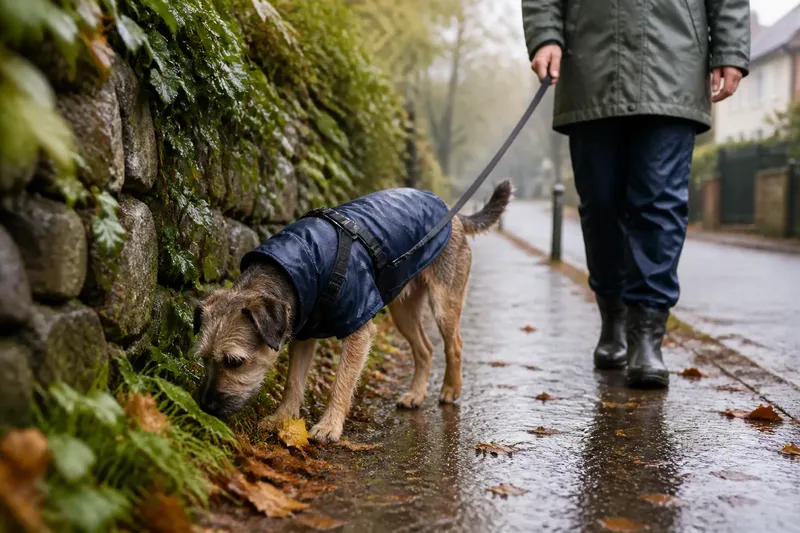
A rainy-day walk with time for sniffing can be a small loop past the same hedge, not a soggy march to hit a distance target. On familiar ground, you can watch your dog investigate the damp air and decide when the outing has done enough.
Why does familiar ground suit a wet walk?
Rain changes a well-known path without making it entirely new. A gate may carry a sharper smell, leaf litter holds moisture, and the edge of a wall offers a sheltered pause. Your dog already knows the route’s broad shape, so there is room to explore these details without the added uncertainty of unfamiliar terrain.
Choose a place you can leave easily: the quiet pavement around the block, a local green with clear paths, or a familiar trail where you know the exits. If a particular stretch turns slick or waterlogged, take another route rather than treating the planned loop as a promise.
Familiarity is not a reason to ignore the dog’s response. A path that is usually calm may feel different under umbrellas, blowing branches or sudden runoff. If your dog hesitates, turns toward home or keeps checking behind, simplify the outing and let the route be shorter.
How can sniffing set the pace?
Leave the lead loose where it is safe and allow a pause at a verge, tree base or dry patch of ground. Sniffing is exploration, not delay to be corrected. A dog may follow one scent for a few moments, lift its head, then choose another spot; that shifting attention is part of the walk.
Keep moving only when the route calls for it. Near a road, shared path or narrow gate, guide your dog along with you, then offer another sniffing pause once there is room. A comfortable pace is not the same as letting the lead trail anywhere: you are still responsible for space, other people and passing dogs.
Rain can make scent-rich places tempting, especially muddy verges and puddle edges. Let your dog investigate where the footing is sound, but steer away from rubbish, broken ground and water whose depth or contents you cannot judge. A brief, safe sniff is more useful than wrestling over every interesting patch.
What makes wet-weather kit comfortable?
Check the fit of your dog’s harness or collar before setting off. A coat can help some dogs feel more comfortable in cold rain, while others move more freely without one; watch for rubbing, restricted steps or repeated attempts to shake it off. Follow the maker’s care and fitting instructions for equipment, and adapt to your dog’s needs and local rules.
- Choose a secure lead that is comfortable to hold when damp.
- Keep a towel by the door for paws, belly and coat.
- Bring bags and a small treat pouch in a pocket you can reach easily.
- Use footwear with a grip you trust on wet pavements or paths.
- Check that any coat or harness stays in place without pinching.
There is no need to buy a full wet-weather wardrobe. If your dog is comfortable and your route is manageable, a towel and familiar equipment may be all the preparation needed. The more useful question is whether your hands stay warm enough to manage the lead calmly.
When should you shorten or change the outing?
Notice the small signals rather than waiting for a dramatic refusal. Shivering, a tucked posture, repeated paw-lifting, reluctance to move or an unusually hurried pull toward shelter can all suggest that your dog wants a change. A pause under cover or a direct return home may suit better than pressing on.
Footing matters for you as well as your dog. Avoid slippery slopes, flooded paths and places where moving water hides the edge. If conditions make it hard to see where you are stepping or to keep a secure hold on the lead, choose a safer, shorter route.
Say you reach a familiar green and your dog sniffs the same hedge, then stops as rain begins to blow across the path. You could turn toward the sheltered pavement, allow one last pause where the ground is firm, and head home; the observable result is a calmer return without asking your dog to push through discomfort.
How do you handle the return home?
Make the doorway the natural end of the outing, not another test. Set the towel within reach before you leave, then dry your dog gently, paying attention to muddy paws and the underside of the coat. If your dog dislikes having its feet handled, wipe one paw at a time and pause when it needs a moment.
Check between the toes for grit, small twigs or clumped mud, and look over the coat for anything caught in it. Keep the routine unhurried; a dog that has already asked to come in may not welcome a long inspection. If you notice a concern that does not settle, seek advice from a veterinary professional.
Dry leads and coats according to their care instructions, and leave them somewhere they can air out. A simple landing routine means wet gear does not spread across the home, while the dog can settle without being fussed over.
What do people ask about rainy-day walks?
Should a rainy-day walk still follow a set route?
Keep a familiar starting point, but treat the route as an option rather than a quota. A short loop, a pause under cover or an early return can all make sense if the weather or your dog’s comfort changes.
Is it all right to let a dog sniff for much of the walk?
Yes, where the place is safe and the lead remains under control. Sniffing can be the main activity of a low-key outing; guide your dog past hazards and offer more freedom again when the path allows.
What if my dog refuses to walk in the rain?
Do not drag your dog along to complete a planned route. Try a brief trip to a familiar, sheltered spot, then head home if your dog remains uncomfortable; persistent or sudden changes in willingness to go out are worth discussing with a vet.
How long should a wet-weather walk last?
There is no single duration that suits every dog or day. Let the route, conditions and your dog’s body language guide the outing, and remember that time spent investigating a few safe scents can be more satisfying than covering extra ground.
A rainy-day walk with time for sniffing works best when the return is as easy as the start: choose a route with a clear way home, leave room for a pause, and keep the towel ready by the door. Then the next shower need not turn a simple outing into a contest against the weather.