Why Short Training Sessions Leave Room to Learn
Why short training sessions help your dog respond clearly, while giving you time to notice what is working and adjust the next practice.
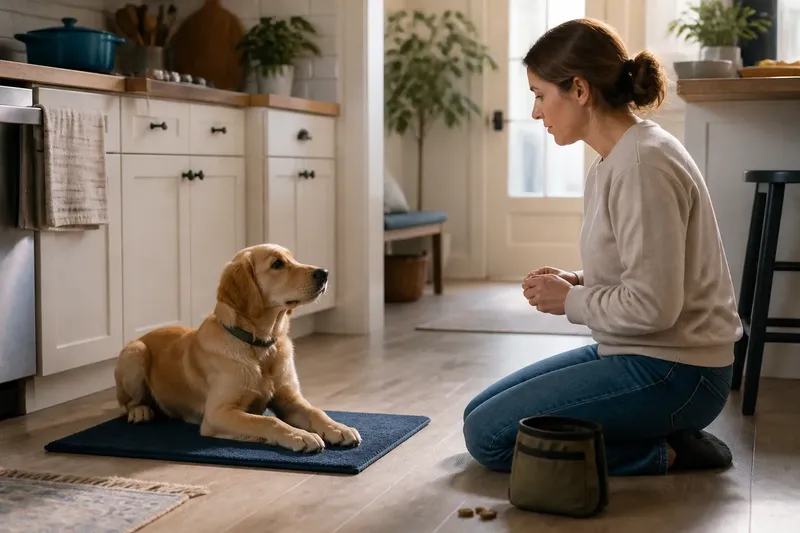
Why short training sessions leave room to learn becomes clear when a dog starts guessing instead of responding. Imagine you are teaching a young dog named Mabel to settle on a mat while you prepare dinner. After a few repetitions, she wanders off, noses the mat’s edge and watches your hands. Rather than repeating the cue louder, you pause. That pause can tell you more than another run-through.
Mabel is invented, and so is the kitchen scene; it is a way to follow one ordinary training problem from its starting point to a possible result. The useful idea is not that every dog needs the same session length. It is that focused practice, broken up by observation, gives both dog and person a clearer chance to respond.
What is Mabel being asked to learn?
At the start, Mabel’s person wants her to go to a mat and remain there while dinner is prepared. That sounds like one behaviour, but it bundles several small skills: noticing the mat, moving towards it, placing paws on it, settling, and staying there as the room changes.
If the person says “mat” while pointing, luring with food, shifting their feet and reaching for a pan, Mabel has plenty to interpret. A short practice gives the person a chance to make the request simpler: put the mat in a quiet spot, stand still, give the cue once and reward the movement they are teaching.
The first aim need not be a long stay. The person can reward Mabel for stepping onto the mat, then end that attempt before asking for more. A clear finish—such as a consistent release word—helps distinguish “settle here” from “you can move now.”
Why stop while the dog is still engaged?
In the imagined first session, Mabel steps onto the mat several times, then turns to sniff the floor. Her person notices the change and ends practice with a simple, familiar cue and a reward. That is not a declaration that Mabel has mastered settling; it is a decision not to keep repeating a request when attention has shifted.
Long strings of repetitions can blur the information. If the dog begins to drift, the person may add extra gestures or repeat the cue, and it becomes harder to tell which part helped. A pause creates room to ask whether the task was too difficult, the surroundings too distracting, or the timing unclear.
Stopping does not need to mean ending on a perfect performance. If Mabel has become restless, the person can make the next attempt easier or take a break. The practical goal is to protect the clarity of the next opportunity, not to squeeze in one more repetition for its own sake.
What should the person watch between attempts?
During the pause, the person can look at Mabel rather than rehearse the cue in their own head. Is she still oriented towards the mat? Does she move readily when invited, or hesitate? Is she searching the floor for dropped food, tracking the person’s hands, or responding to kitchen sounds?
These details help separate a training problem from a setting problem. If the mat sits beside a busy doorway, movement may keep pulling Mabel’s attention away. If the person’s reward arrives only after she has already stepped off, the timing may be confusing. A pause gives the person time to choose one adjustment instead of changing several things at once.
For example, the person might move the mat farther from the kitchen traffic while keeping the cue and reward method unchanged. In the next brief attempt, they can see whether Mabel finds the mat more readily. The result is useful information even if she still needs help settling.
How can practice grow without turning into a marathon?
In the hypothetical case, Mabel’s person first rewards the approach and paw placement. When those become easy in the quiet kitchen, the person can ask for a moment of stillness before releasing her. Later, they might practise while moving a plate or opening a cupboard, changing only one feature at a time.
That progression is more informative than making the session longer simply because Mabel had a good start. Duration, distance, distractions and the person’s movement can each make the task harder. If several change together, a stumble does not reveal which one was too much.
A modest practice pattern could look like this:
- Choose one observable action to reward, such as stepping onto the mat.
- Give the cue once and allow time for Mabel to respond.
- Mark the response with a brief word or click, then deliver the reward promptly.
- Pause and notice her attention, movement and response to the setup.
- Make one adjustment for the next attempt, or finish if she seems ready for a break.
These are choices, not a rigid schedule. A dog who is relaxed and engaged may manage more practice than one distracted by noise or tired after a busy day. The person can keep the cue familiar and the expectations modest while adapting the pause to what the dog is showing.
What can a pause reveal about rewards and cues?
Suppose Mabel steps onto the mat but immediately looks at her person’s pocket. That may suggest she has noticed where food comes from more strongly than what earned it. In the invented scenario, her person can keep the treat out of sight, mark the moment her paws reach the mat, and then take the reward from a nearby container.
The point is not to hide every reward or make a dog work without reinforcement. It is to make the connection between the requested action and the reward easier to read. If Mabel only moves when she sees food in a hand, the person may need to practise the cue with the hand still and reward after the response.
Pauses also make it easier to notice whether a cue has become background noise. If the person has repeated “mat” several times while Mabel is distracted, the next attempt can begin after her attention returns. One cue, a clear opportunity to respond, and a well-timed reward are easier to interpret than a stream of repeated prompts.
When does short practice need a different plan?
Not every difficulty is solved by making a session shorter. If Mabel avoids the mat, freezes, pants heavily, or seems unsettled, her person should not keep pressing for a response. They can remove the demand, check whether the surface or location is uncomfortable, and seek qualified help if the concern persists or seems connected to pain or distress.
For a dog who understands the action but loses focus around lively household activity, the person can practise in a calmer place before bringing the same skill into a busier room. If the behaviour is important for safety or is linked to serious fear or aggression, a qualified, reward-based trainer or veterinary professional can help tailor an appropriate plan.
What questions come up about short training sessions?
How short should a dog training session be?
There is no single duration that suits every dog or task. Stop when attention begins to fade, responses become less clear, or the dog needs a break, and use the next attempt to match what you observed.
How many repetitions should I ask for?
Ask for enough practice to see whether the dog understands the current version of the task, not a fixed quota. If the response becomes hesitant or inconsistent, pause and consider making the next attempt easier.
Should I end after a mistake?
A mistake does not require an abrupt end, but it can be a cue to simplify the request. If the dog is still comfortable, offer an easier opportunity; if attention or ease has clearly faded, finish calmly and try again another time.
Can I practise several skills in one session?
You can, but switching between cues may make it harder to see what is improving, especially while a skill is new. For Mabel’s mat work, her person keeps the focus on that one behaviour and leaves other familiar cues for another practice period.
What changes by the end of Mabel’s imagined practice?
After several brief attempts across ordinary days, imagine Mabel walking to the mat when her person gives the cue in the quiet kitchen. She stays there briefly while a plate is set down, then receives her release and reward. That is a plausible next result in this invented situation, not a promise that every dog will progress in the same way.
The more useful change is in the person’s decisions. They have learned to notice when Mabel is following the cue, when a distraction is competing, and when a small adjustment is more helpful than another repetition. The mat skill can then grow gradually, with each practice offering a fresh chance to observe.
Why short training sessions help is not that brief practice magically produces a settled dog. It is that a pause gives the handler evidence to work with: the dog’s response, the timing of the reward and the effect of the surroundings. Keep that pause in the plan, and the next cue can be clearer for both of you.